
The days of optimising pages purely around keywords are slipping away. Search engines and AI assistants no longer just look for strings of text — they look for things. In technical terms, these things are “entities”: people, organisations, services, places, and concepts that exist independently of wording.
If your brand is not recognised as an entity, you risk being invisible in the new landscape of search and AI-generated answers. This post explains what Entity SEO is, why it matters, and how to build your business into something that both Google and large language models (LLMs) understand and trust.
Keywords vs Entities
For years, SEO was keyword-driven. You picked terms, optimised content around them, and built links to reinforce relevance. That still matters, but search engines have become more sophisticated.
Google’s Knowledge Graph, introduced in 2012, started treating “Victory Digital” as more than just two words. Instead, it sees an organisation entity linked to services (SEO, PPC, AI assistants), industries (digital marketing, AI marketing, care home marketing, etc), and places (UK, Barnstaple, Devon, etc).
Whereas keywords are surface-level, entities are deeper, contextual connections.
Why entities matter to LLMs
Large language models like ChatGPT and Google’s Gemini don’t crawl the web the way a search engine spider does. They learn by consuming structured and unstructured data, then mapping connections between entities.
When someone asks, “Who are the best SEO agencies in the UK?” an LLM won’t just scan for repeated keywords. It looks for recognised entities that are consistently associated with:
-
Credible definitions (what the organisation does)
-
Evidence of authority (citations, reviews, mentions)
-
Relationships to other entities (services, clients, industries)
If your brand does not exist as a clearly defined entity, you will not appear in those answers — even if you have strong keyword coverage.
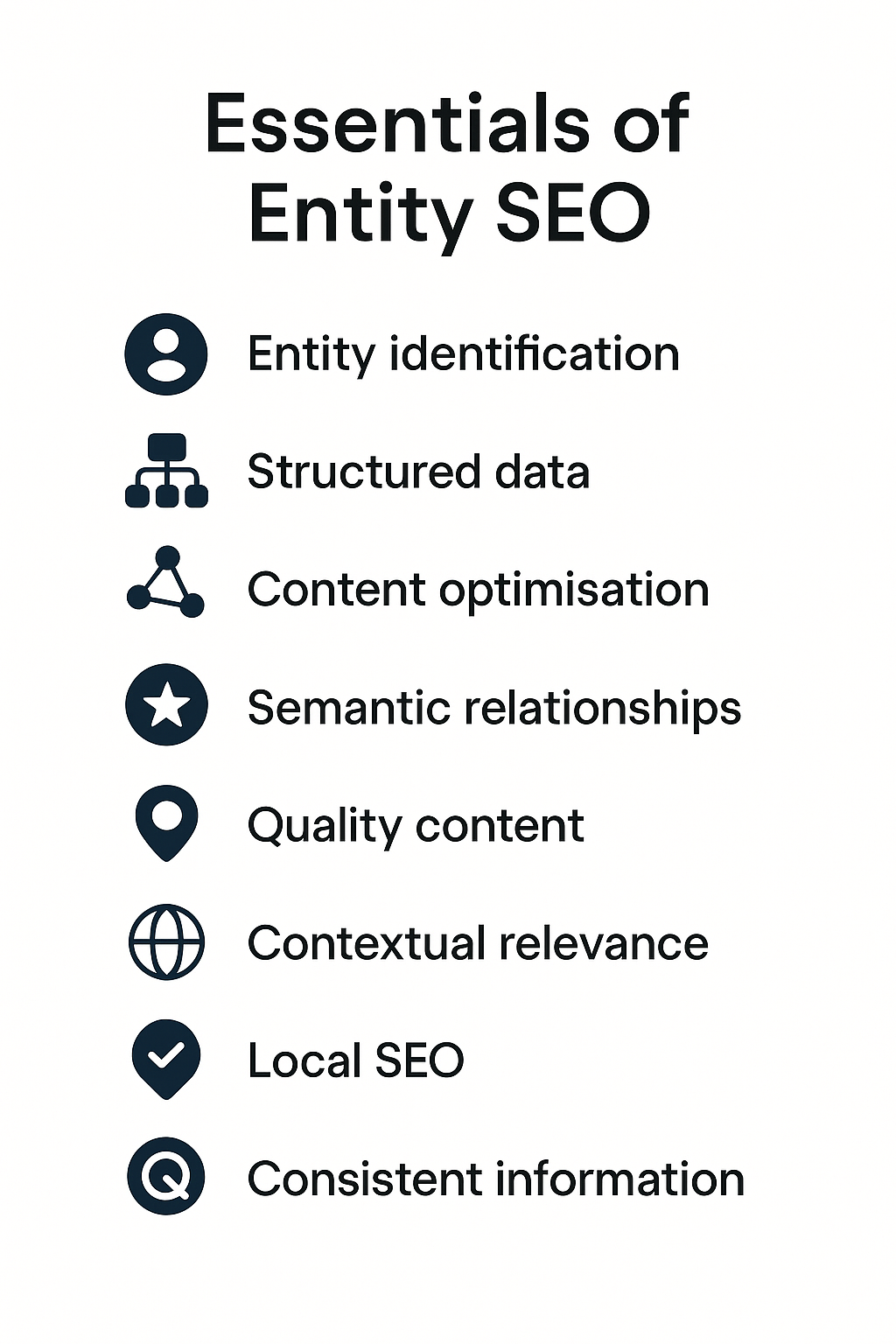
Entity SEO in action
Imagine a care home group looking to improve visibility. Their “Care Home Marketing” page is written around keywords, but it’s vague. After restructuring with an entity-first mindset, it now:
-
Defines the service clearly: “Care home marketing is the practice of promoting residential care services through digital and offline channels.”
-
Links out to related entities: “Care homes in the UK,” “CQC,” “digital marketing services.”
-
Uses schema to confirm the relationships.
-
Has corroboration through client testimonials and a LinkedIn presence.
Result: The brand begins appearing not only in Google’s results but also in AI-generated overviews where “care home marketing agencies” are discussed.
Tools and tactics for Entity SEO
Here are a few tools that help uncover and optimise your entity presence:
-
Google’s Knowledge Graph API: See if your brand is already recognised as an entity.
-
Schema.org validator: Check if your markup is structured correctly.
-
Kalicube Pro: A platform focused on entity-based optimisation and brand SERP building.
-
Internal linking maps: Tools like Screaming Frog or Sitebulb to visualise how your entities connect internally.

Victory Digital’s approach
At Victory Digital, we treat entities as the building blocks of modern SEO. Our process includes:
-
Building entity maps for clients, outlining how their organisation, services and industries connect.
-
Implementing schema strategies that reinforce those entities for search engines and LLMs.
-
Publishing thought-leadership content that positions clients as trusted voices worth citing.
-
Tracking visibility not just in Google rankings, but also in AI assistant outputs.
Our aim is simple: to make your brand impossible to ignore, whether someone is searching traditionally or asking an AI assistant a question.
Book a Call
Victory Digital runs Entity SEO audits that map your current presence, identify gaps, and build a plan to make your brand unmissable in the era of AI-driven discovery.