
If your organic strategy still assumes “ten blue links”, you are solving yesterday’s problem. People are asking conversational questions and expecting direct, confident answers. That shift does not kill SEO, it evolves it. Generative Engine Optimisation (GEO) is the discipline of making your brand easy for answer engines and large language models (LLMs) to understand, trust and reference, while still winning classic rankings.
Below is a practical, no-fluff playbook you can run over the next 90 days.
Why GEO matters now
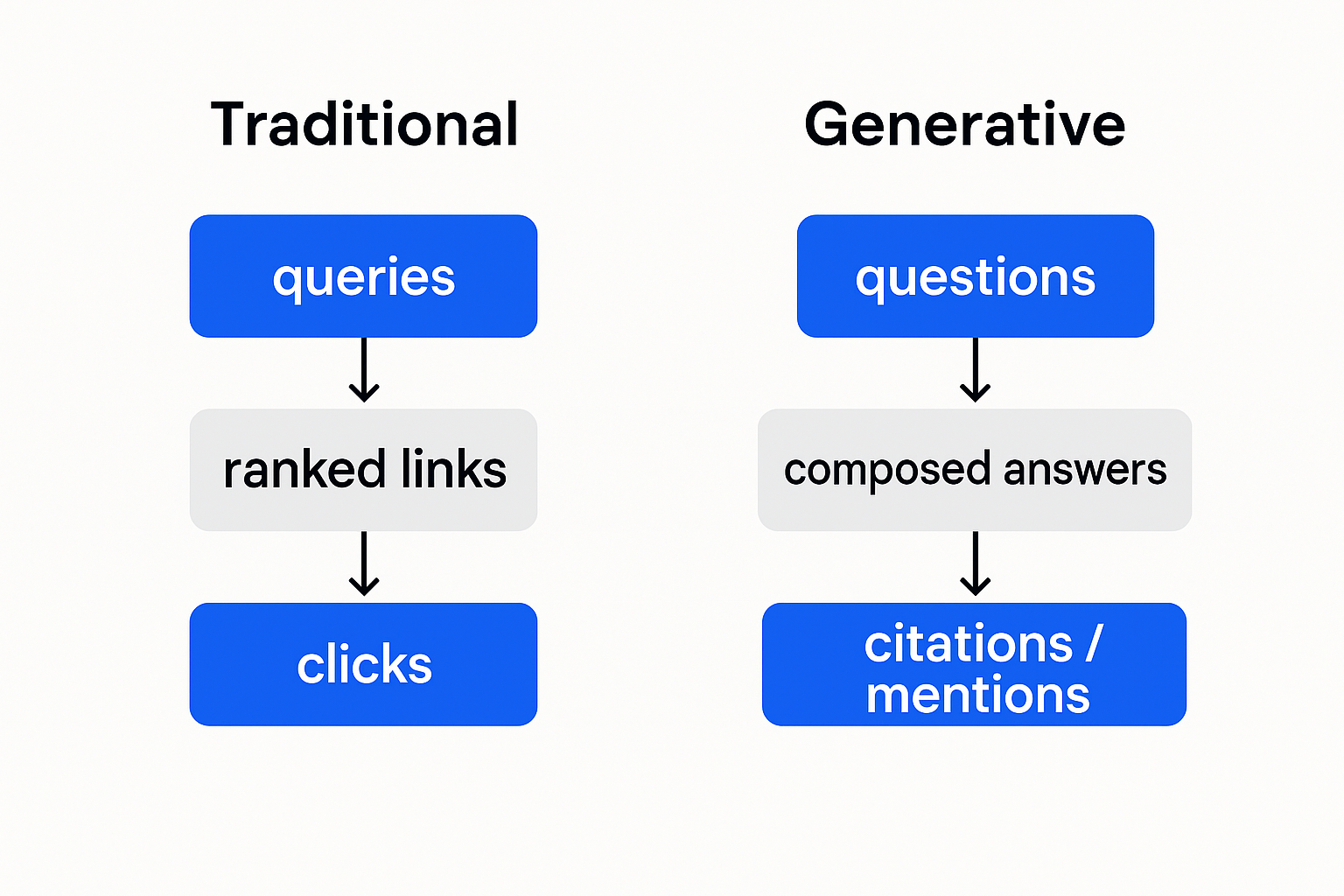
Search has split into two discovery paths:
-
Traditional: queries → ranked links → clicks
-
Generative: questions → composed answers → citations or mentions (sometimes links, sometimes not)
In both paths, clarity, credibility and coverage decide who appears. GEO is about engineering those three things on purpose so your pages rank and your brand is eligible to be cited by AI assistants.
The GEO framework
1. Entities and evidence (make the “who” and “what” undeniable)
Think like a librarian. LLMs and modern search rely on entities, persistent “things” like your organisation, people, services and products. Build an entity map: your company (as the root) → service entities (SEO, PPC, Social, Content, AI Assistants) → supporting concepts (industries, locations, tools).
Practical steps:
-
Create or refresh “About”, “Team” and “Service” pages so each entity has a canonical page with a clear definition, benefits in plain English, and links to related entities.
-
Add external corroboration: consistent business details across profiles, authoritative mentions and thought-leadership posts that answer non-trivial questions in your niche.
2. Structured data that says the quiet part out loud
Schema markup gives machines unambiguous facts. Prioritise:
-
Organisation (logo, sameAs, contact points), Service, Product (if packages), and FAQ schemas
-
Article schema on every blog post (headline, author, datePublished, mainEntityOfPage)
-
For visual explainers or step-by-steps, add HowTo schema where relevant and safe
Implement in JSON-LD, validate with Search Console and a schema tester, and re-validate after updates.
3. Content designed for answers, not just keywords
Keep writing for humans, but package information so an answer engine can lift it cleanly:
-
Lead with the plain answer in the first two or three sentences
-
Follow with the “why” (context), then the “how” (steps, examples), then a “next action” (CTA)
-
Add a short FAQ at the end using the real questions your sales team gets
-
Use specifics: numbers, names, tools and constraints. Vague prose looks untrustworthy to both humans and machines.
4. Accessibility and performance (crawl, render, trust)
Fast, easily rendered pages get seen. Easily seen pages get referenced. Fix:
-
Core Web Vitals issues, especially CLS and LCP on service pages
-
Internal links from blogs to the most relevant service page (e.g. AI posts to AI Digital Marketing or GEO, PPC posts to Pay Per Click)
-
On-page UX basics: scannable headings, descriptive alt text, readable contrast, mobile-friendly tap targets
Your first 90 days
Weeks 0–2: Discover and define
-
Run a technical and structured-data audit
-
Build your entity map and pick one or two flagship services to focus on first
-
Document 10 to 15 real buyer questions per service from inboxes, CRM and sales calls
Weeks 3–5: Ship credibility
-
Rewrite service intros to answer “What is it? Who is it for? What outcome?” in 60–80 words
-
Add Organisation, Service and FAQ schema to priority pages
-
Publish one evidence-led post such as a case study, teardown or contrarian opinion that other sites would cite
Weeks 6–9: Package answers
-
Publish two “question-first” posts (e.g. “How do we structure service pages for Google and AI Overviews?”)
-
Add an FAQ section to each priority service page using the buyer questions gathered earlier
-
Tighten internal links so every post nudges readers to a relevant service page and a case study
Weeks 10–12: Close the loop
-
Create a short content brief template for your team that includes: answer → context → how → CTA + schema checklist
-
If you have enough support volume, design a custom AI assistant that can field pre-sales questions using your tidy knowledge base, then test it on a low-risk page
How to measure GEO without guesswork
-
Query mix shift in Search Console, with more “problem” and “how” queries landing on service or blog pages
-
Branded plus concept impressions, such as YourBrand + SEO pricing or YourBrand + AI overview
-
Assisted conversions from content, visible in your marketing dashboard
-
Mention quality, more citations or quotes from credible domains in referral traffic
-
Time to useful answer, meaning when a prospect asks a question, you can send a single link that answers it fully
Where we can help
We have built repeatable ways to align technical SEO, content and AI discoverability. If you want a 90-day GEO plan designed around your market and resources, we will map it, implement critical schema and stand up the content cadence. You will see progress in your Client Dashboard, all in one place.